

Marcus
Ask me anything, I am here to help you.
Enquiry Form
Enquiry Form
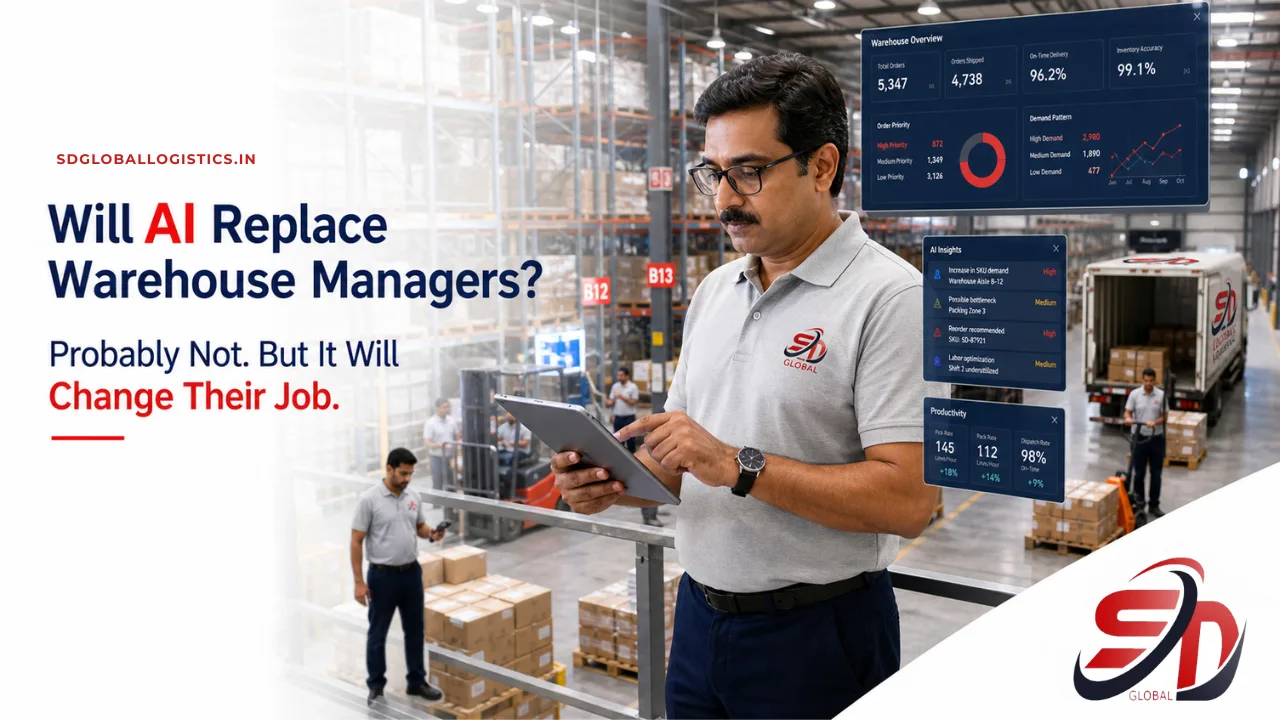
Warehouse managers will not be replaced by AI. Human judgment, leadership, exception handling and real-time coordination are still required in warehouses. But AI will be making more routine decisions — and get managers in the habit of data-driven management and problem-solving in operations. Such a transition is already in the process. And if you manage a warehouse, run a 3PL operation, or oversee supply chain logistics in India, it directly affects how you plan, hire, and operate.
The global AI in warehousing market size reached
USD 12.69 billion in 2025
and is expected to rise to
USD 83.42 billion in 2034 with a CAGR of 23.10%. 41% of supply-chain organisations currently use AI, with a further 47% planning to adopt it within five years. However, just 25% of warehouses in the world are automated, which means most of the warehouse activities are still mainly dependent on human coordination.
This is not a "robots are taking over" story. It is a story about tools becoming smarter and managers needing to use those tools better.
Forget vague claims. Here is what AI-powered warehouse technology does in practice today.
In a 2025 survey, nearly 45% of companies reported using machine learning for demand forecasting, and almost half applied AI in multiple functions such as inventory and supply-chain management.
By examining trends from past sales, seasonal variations, and external factors, AI can make precise recommendations for replenishment, minimizing overstock and stockout scenarios.
AI systems now track how fast individual products move (known as SKU velocity), reorganise pick faces before congestion builds, and flag optimal replenishment windows.
This used to require a manager to manually analyse movement data. Now it happens in near real time.
AI monitors equipment performance — forklifts, conveyors, automated storage systems — and flags maintenance needs before breakdowns occur. This prevents costly downtime without waiting for a human to notice a problem.
AI platforms can model staffing requirements based on incoming order volumes, seasonal peaks, and fulfilment deadlines. Managers receive shift planning recommendations rather than building rosters from scratch.
AI can scan thousands of transactions to flag inventory discrepancies, pick errors, or unusual patterns — surfacing problems a manager might take hours to find manually.
Real-time dashboards replace manual reporting. Managers see live KPIs — fill rates, pick accuracy, dock utilisation, SLA compliance — without pulling data from multiple sources.
This is where the conversation gets more honest.
It cannot motivate a team during a peak-season surge, resolve a conflict between two shift workers, or recognise when an experienced picker is burning out.
A supplier truck that arrives three hours late, a sudden bulk return from a major e-commerce client, or a power failure that disrupts automated systems — these situations require a human who can assess context, make trade-offs, and communicate in real time.
When a shipment goes wrong, a client needs a person to take ownership, explain what happened, and commit to a solution. AI can provide data. It cannot provide responsibility.
| Area | Traditional Management | AI-Supported Management |
|---|---|---|
| Inventory forecasting | Manual review of historical data | AI-generated replenishment recommendations |
| Slotting decisions | Periodic manual review | Continuous AI-driven SKU velocity tracking |
| Workforce scheduling | Experience-based roster building | AI-assisted shift planning by order volume |
| Exception handling | Spotted manually or after delays | Real-time AI alerts and anomaly detection |
| Reporting | End-of-day manual reports | Live performance dashboards |
| Predictive maintenance | Reactive (fix after breakdown) | Proactive (AI flags before failure) |
| Human judgment | Everywhere | Still required for escalations, teams, clients |
The real power of AI in warehousing comes when it is connected to a strong Warehouse Management System (WMS). Here is a simple workflow:
Operational Data → WMS → AI Analysis → Recommendation → Manager Decision → Action
What each step means:
Every scan, transaction, pick, receipt, and movement feeds the system.
Organises and structures data across inventory, orders, and workflows
Identifies patterns, flags exceptions, and generates recommendations.
Surfaces a specific insight: "Replenish SKU-4421 in Zone B before Thursday."
The human reviews context, confirms or adjusts the recommendation.
The team executes
Cloud-supported Warehouse Management Systems provide predictive insights, enabling managers to allocate labour and space more efficiently.
The WMS does not replace the manager. It makes the manager better informed.
The warehouse manager is moving from Manual Supervisor to Data-Driven Operations Leader.
A manager's day was dominated by:
A manager's day increasingly involves:
A practical checklist for warehouse managers and operations leaders.
The India logistics automation market was valued at USD 2,181.07 million in 2025 and is projected to reach
USD 8,010.64 million by 2034, growing at a CAGR of 15.55%. India's e-commerce market is projected to reach nearly USD 130 billion by 2025, alongside the increasing trend of quick commerce and organised retail, which are also driving the growth of warehouse automation in India. Expectations of same-day and next-day delivery are challenging the traditional warehouse model, and companies are investing in smarter warehouse infrastructure as a result.
For 3PL providers, e-commerce fulfilment operators, and contract logistics players in India, the question is no longer whether to adopt warehouse management technology — it is how fast and how well.
Tier-2 and Tier-3 cities such as Lucknow, Jaipur, and Coimbatore are becoming fulfilment growth centres in India, where smarter warehouse management is going beyond metros to expand.
AI is not going to appear in your warehouse and give a warehouse manager a redundancy notice.
It will do — and indeed it already does — is eliminate the time-wasting repetitive, information-gathering activities that used to consume a manager's day. What remains is more important: leadership, problem-solving, client management, team development, and the judgment call that no algorithm can own.
63% of warehouse decision-makers are considering the use of AI software within five years, meaning that those decision makers who know how to work with AI software will outperform those who are still learning when the transition comes.
The warehouse manager's job is not disappearing. It is upgrading.
From growing businesses to established enterprises, companies rely on SD Global Logistics to manage critical warehousing and logistics operations.















" We struggled with inconsistent inventory handling until SD Global stepped in with dedicated warehousing and tight process control. Their attention to detail brought stability to our entire supply chain. "

" Reverse logistics was a major pain point for us. With SD Global’s reverse logistics management and WMS integration, we finally got the visibility and efficiency we needed. "

" As a growing startup, flexibility was key. SD Global’s on-demand warehousing and responsive support scaled with us without locking us into rigid contracts. "

" Order delays used to slow us down. Thanks to SD Global’s order fulfillment and B2B logistics, we’re now running faster and more reliably than ever. "

" Our nationwide expansion needed a reliable network. SD Global’s Pan-India 3PL and shared warehousing model gave us the reach and agility we were missing. "

Warehouse managers will not be replaced by AI. Human judgment, leadership, exception handling and real-time coordination are still required in warehouses.But AI will be making more routine decisions — and get managers in the habit of data-driven management....
View Blog
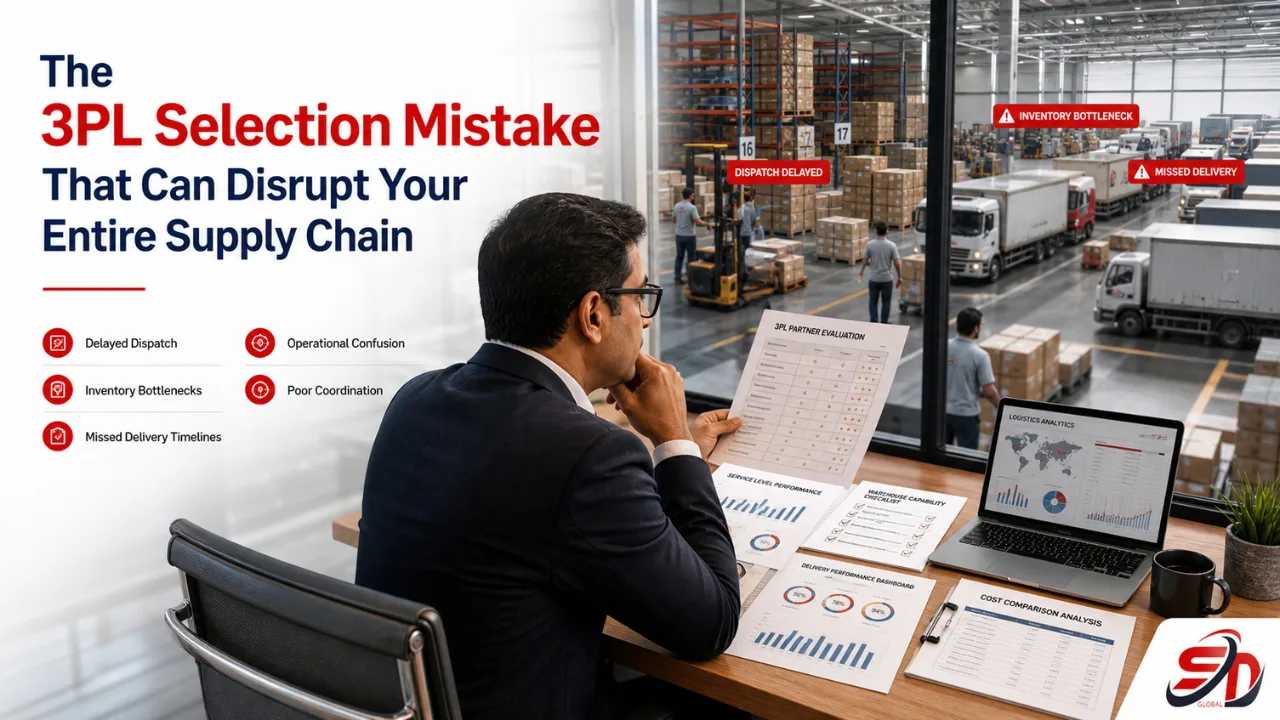
The most common error that companies make when choosing a 3PL is simply looking at the cost or warehouse capacity without assessing operational capability, technology, network, scalability, service levels and supply chain impact.
View Blog
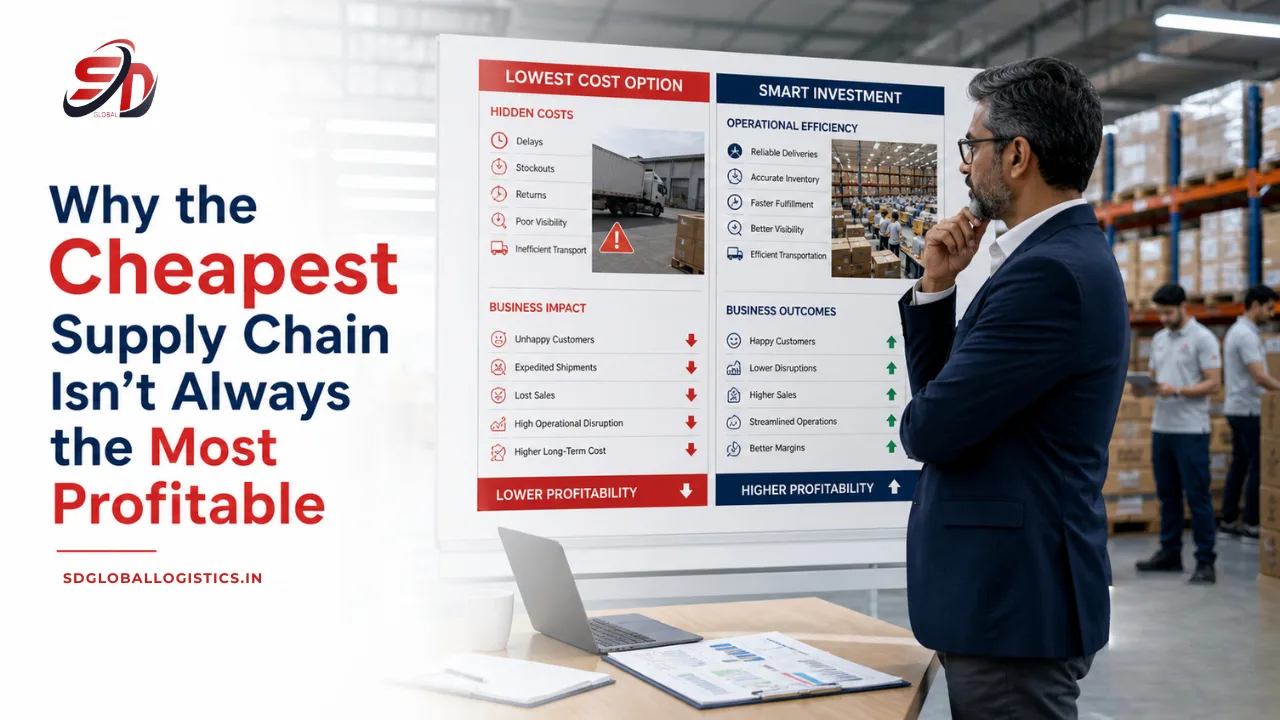
The cheapest supply chain is not always the most profitable — because cutting costs in one area almost always creates higher costs somewhere else. A low-cost warehouse in a remote location adds cos to transportation. The lower the wages, the more mistakes get made.
View Blog75+ warehouse locations positioned across major industrial, commercial and distribution markets.
SD Global Logistics — your pan-India partner delivering scalable warehousing, technology-driven supply chain solutions and reliable, cost-efficient logistics for growing businesses
Developed By Rapiditors Technology India Pvt Ltd © 2025. All rights reserved.
Marcus
Ask me anything, I am here to help you.