

Marcus
Ask me anything, I am here to help you.
Enquiry Form
Enquiry Form
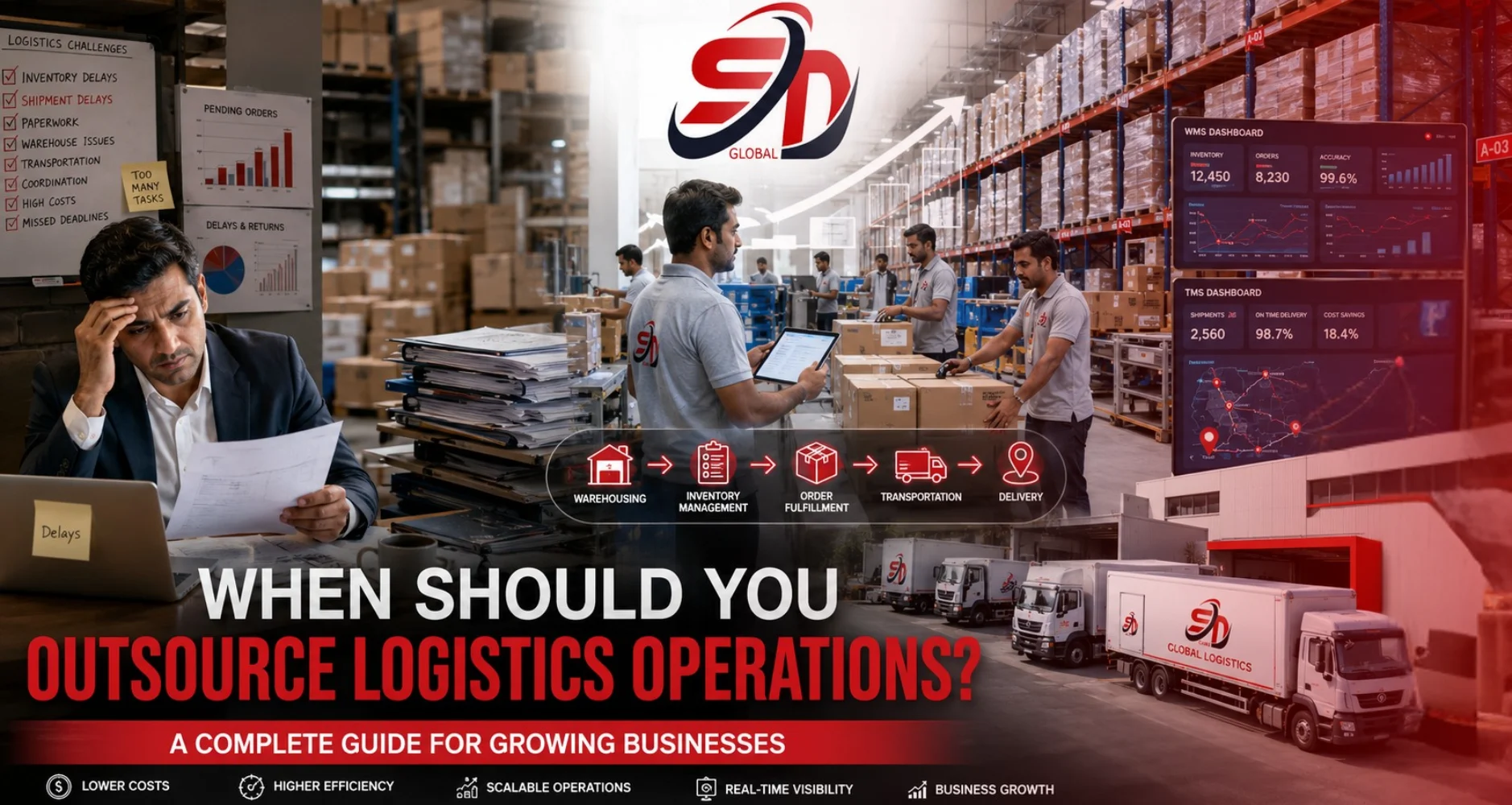
Every expanding business will sooner or later face a dilemma: Do you maintain your own logistics or delegate them to a specialist? This is a serious economic matter, and as such can cost you a fortune in terms of time, money and customer confidence.
The reality is, there is no set trigger point. But there are clear, recognizable signals that tell you it's time to seriously consider outsourcing warehousing and logistics. In this guide, we'll walk through the key signs, the benefits, and how to think strategically about partnering with a third-party logistics provider — so you can make the right call for your business.
The logistics outsourcing industry is not only expanding — it is also evolving very fast. The logistics outsourcing industry is expected to sustain a higher growth rate of 4.8% CAGR through 2035. And in India specifically, the 3PL market size in 2026 is estimated at USD 38.18 billion, growing at a 5.78% CAGR toward USD 50.55 billion by 2031.
Why are so many businesses making this shift? The anticipated growth is driven by increasing demand for speedy order fulfillment, a preference for cost-effective logistics solutions, the rapid expansion of retail and manufacturing supply chains, and greater dependence on professional logistics partners.
In simple terms, supply chains have gotten too complex — and too critical — for most companies to manage alone. If you're running an ecommerce brand, a D2C business, or a manufacturing operation in India, the question isn't whether you'll eventually need a partner. It's when should a business outsource logistics — and whether that moment has already arrived.
Not every business needs to outsource logistics on day one. But if you recognize yourself in any of the scenarios below, it may be time to start evaluating third party logistics services India has to offer.
1. Your Order Volume Has Outgrown Your Setup:
This is the most common trigger. As there is a backlog of orders and your current warehouse, team or shipping procedure is unable to keep up, fulfillment quality decreases. Late deliveries, packing errors, mismatches in inventory are common occurrences. Orders piling up, deliveries lagging, and customers fleeing to competitors is a harsh reality for 39% of retailers facing slipping delivery performance, where frustrated customers abandon carts at rates up to 70% due to slow or expensive shipping.
One of the most obvious indications that you need a 3PL provider is when you are spending more time fighting fires over logistics than you are working on expanding your business.
2. Logistics Costs Are Rising but Service Quality Isn't:
Running your own fleet, warehouse personnel, stock of packaging materials, and shipping contracts, entails a continuous monitoring of these functions. As your company grows, these expenses may become disproportionately higher especially if you don’t negotiate volume-based rates with carriers or do not have optimally designed warehouse areas.
Outsourcing logistics functions can lead to cost savings because 3PL providers often have economies of scale, advanced technology, and specialized expertise that can reduce transportation, storage, and labor costs.
By turning to a logistics service provider in ecommerce, you can quite often receive a higher level of service at a reduced per-unit cost simply because the provider’s main business is logistics rather than a secondary function.
3. You Lack Technology and Real-Time Visibility:
Today’s logistics management services heavily depend on warehouse management systems (WMS), order management platforms, and tools for real-time tracking. Operating on spreadsheets or silos systems means you are practically in the dark. 3PL providers now offer integrated tech platforms, wide distribution networks, and expert teams - all capabilities that many companies internally cannot maintain.
The most advanced warehouse management services provide you real-time inventory accuracy, the automation of pick-and-pack processes, complete shipment visibility, and access to sophisticated technologies that would require a large capital investment if you choose to build them yourself.
4. You're Expanding Into New Markets or Channels:
New marketplace launch? Omnichannel? New city or state? Every new channel means an extra layer of details — different SLAs, packaging requirements, flow of returns, and delivery schedules.
On day one, an experienced ecommerce fulfillment partner come fully equipped with both the infrastructure and the processes necessary to plug into multiple channels. Building all that internally while running your business will lead you to a strained operation.
5. Seasonal Demand Spikes Are Crushing You:
Do you experience drastic volume variations in your business during festivals, sales events, or seasonal peaks? Keeping your logistics setup static means that during the slow periods, you are either overstaffed or during the peaks, you are overwhelmed. The industry's hallmark is its scalability and technical depth, allowing companies — from burgeoning e-commerce startups to global manufacturing conglomerates — to leverage multi-modal networks and sophisticated software without heavy capital investment.
Flexible warehousing and fulfillment services allow you to increase or decrease capacity without being tied to long-term fixed expenses.
6. Returns and Reverse Logistics Are Becoming a Bottleneck: Returns are a core part of the customer experience for e-commerce businesses, not just an optional feature. If your returns process is slow, disorganized, or consuming your profit margins, a third-party logistics provider that has dedicated reverse logistics capabilities can really make a difference.
Knowing the advantages of outsourcing logistics operations is not just limited to cost savings. Here are some of the other things that a proper 3PL can help you with:
Focus on Core Business: Manufacturers can focus their attention on their strengths by outsourcing the activities related to logistics and distribution to specialized companies. In addition, they can optimize the costs related to warehousing, transportation, and overall supply chain management.
Access to Expertise and Infrastructure: Third party logistics are moving beyond the service execution role and becoming more strategic partners. By outsourcing complex logistics tasks, such as omnichannel fulfillment, returns processing and performance optimization, shippers can concentrate on their core business, while benefiting from the expertise, technology and scale of the 3PL.
Lower Logistics Costs: Two-thirds of shippers report that outsourcing contributes to lower logistics costs, while many also credit 3PLs with service improvements and operational innovation.
Technology Without Capital Investment: From AI-driven demand forecasting to automated sortation systems, end to end logistics solutions from a capable 3PL give you access to technology that would cost millions to build independently.
Supply Chain Resilience: Shippers are moving to a new era of logistics outsourcing, driven not just by price, but by agility, service consistency, and transparency of operations, and embracing third-party logistics providers to build resilience and unleash multimodal flexibility.
So, when to hire a 3PL? The honest answer: ideally, before your logistics problems become customer-facing crises.
Here's a practical framework:
Early Stage (under 500 orders/month): You can likely manage in-house with basic tools. Focus on getting product-market fit right.
Growth Stage (500–5,000 orders/month): This is the sweet spot for ecommerce logistics outsourcing. Complexity is rising, but you're not yet locked into expensive fixed infrastructure.
Scale Stage (5,000+ orders/month): If you're not already working with a 3PL, you're almost certainly leaving money and efficiency on the table. At this volume, the best 3PL company in India will deliver measurable ROI within the first few months.
The key principle: outsource logistics when the cost of managing it internally exceeds the cost of doing it well externally. That tipping point arrives sooner than most founders expect.
Not all 3PLs are created equal. When evaluating a potential logistics service provider for ecommerce or any other industry, consider:
Technology stack: Do they offer a modern WMS with real-time dashboards and integrations?
Scalability: Can they handle 10x your current volume without breaking down?
Location and network: Are their warehouses positioned to serve your key demand markets?
Transparency: Do they share performance data, SLAs, and cost breakdowns openly?
Industry fit: Do they understand your category — whether that's fashion, electronics, FMCG, or pharma?
Outsourcing warehousing and logistics shouldn't be perceived as a sign of weakness; it's a deliberate and early move by some of the fastest growing companies worldwide. This growth is driven by increasing supply chain complexity, a rising need for cost efficiency and operational flexibility among manufacturers, and the boom in e-commerce activities.
The Indian market, in particular, is at an inflection point. Growth stems from multi-modal infrastructure upgrades, expanding export manufacturing, and digital platforms that compress delivery lead times while lowering fulfillment costs. For businesses operating in this landscape, the right logistics partner can be transformative.
Companies such as SD Global Logistics are working on building exactly this kind of infrastructure – structured, technology-driven warehouses with scalable logistics capabilities geared towards the Indian market. For businesses looking for a reliable ecommerce fulfillment partner or comprehensive warehouse management services, working with a partner that understands both the technology and the ground-level execution can make all the difference in sustaining long-term growth.
When choosing an ecommerce fulfillment partner or warehousing services provider, it can be key for businesses to find one that grasps the technology and the hands-on logistics to ensure long-term success.
Then, what is it that you decide? Don't let logistics become the biggest source of your pain. Recognize the signs, weigh your options, and change over to when it still feels like you are tactically positioning yourself rather than responding to a crisis situation.
From growing businesses to established enterprises, companies rely on SD Global Logistics to manage critical warehousing and logistics operations.














" We struggled with inconsistent inventory handling until SD Global stepped in with dedicated warehousing and tight process control. Their attention to detail brought stability to our entire supply chain. "

" Reverse logistics was a major pain point for us. With SD Global’s reverse logistics management and WMS integration, we finally got the visibility and efficiency we needed. "

" As a growing startup, flexibility was key. SD Global’s on-demand warehousing and responsive support scaled with us without locking us into rigid contracts. "

" Order delays used to slow us down. Thanks to SD Global’s order fulfillment and B2B logistics, we’re now running faster and more reliably than ever. "

" Our nationwide expansion needed a reliable network. SD Global’s Pan-India 3PL and shared warehousing model gave us the reach and agility we were missing. "
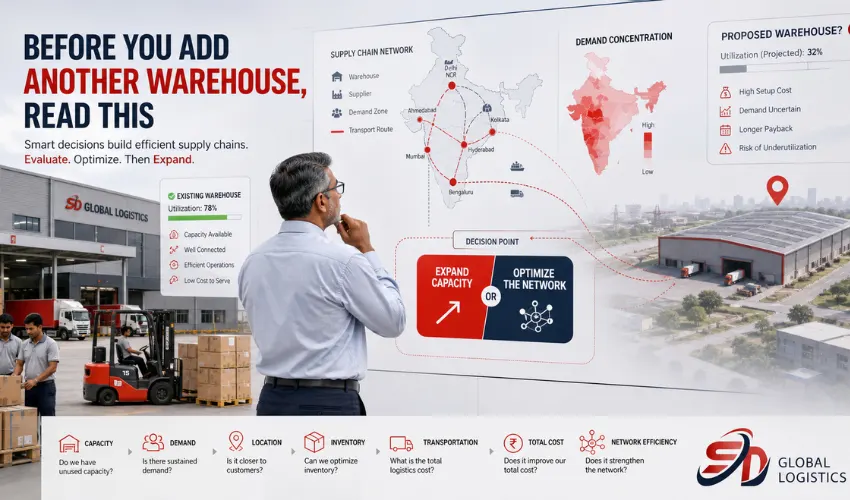

The answer is not always to build another warehouse. Before making a decision on an expansion, companies should look at true capacity utilization, inventory location, customer distribution, transportation costs, operational efficiency....
View Blog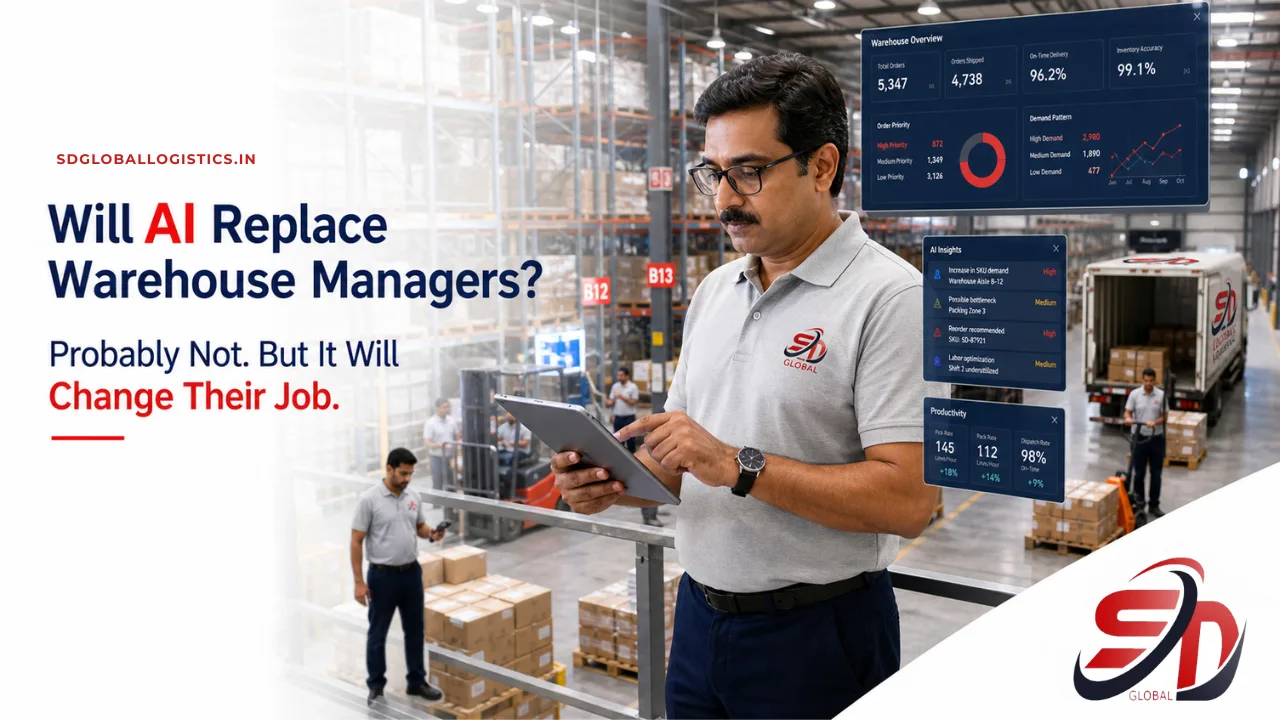
Warehouse managers will not be replaced by AI. Human judgment, leadership, exception handling and real-time coordination are still required in warehouses.But AI will be making more routine decisions — and get managers in the habit of data-driven management....
View Blog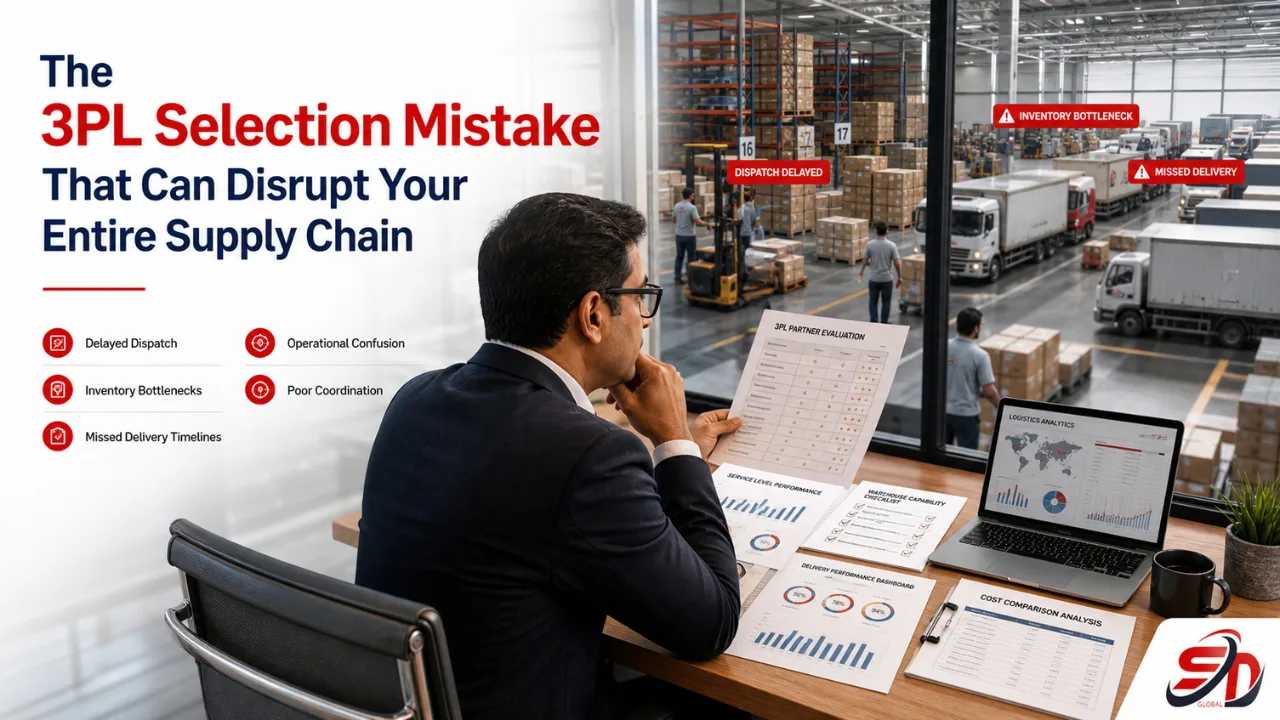
The most common error that companies make when choosing a 3PL is simply looking at the cost or warehouse capacity without assessing operational capability, technology, network, scalability, service levels and supply chain impact.
View Blog75+ warehouse locations positioned across major industrial, commercial and distribution markets.
Marcus
Ask me anything, I am here to help you.