

Marcus
Ask me anything, I am here to help you.
Enquiry Form
Enquiry Form
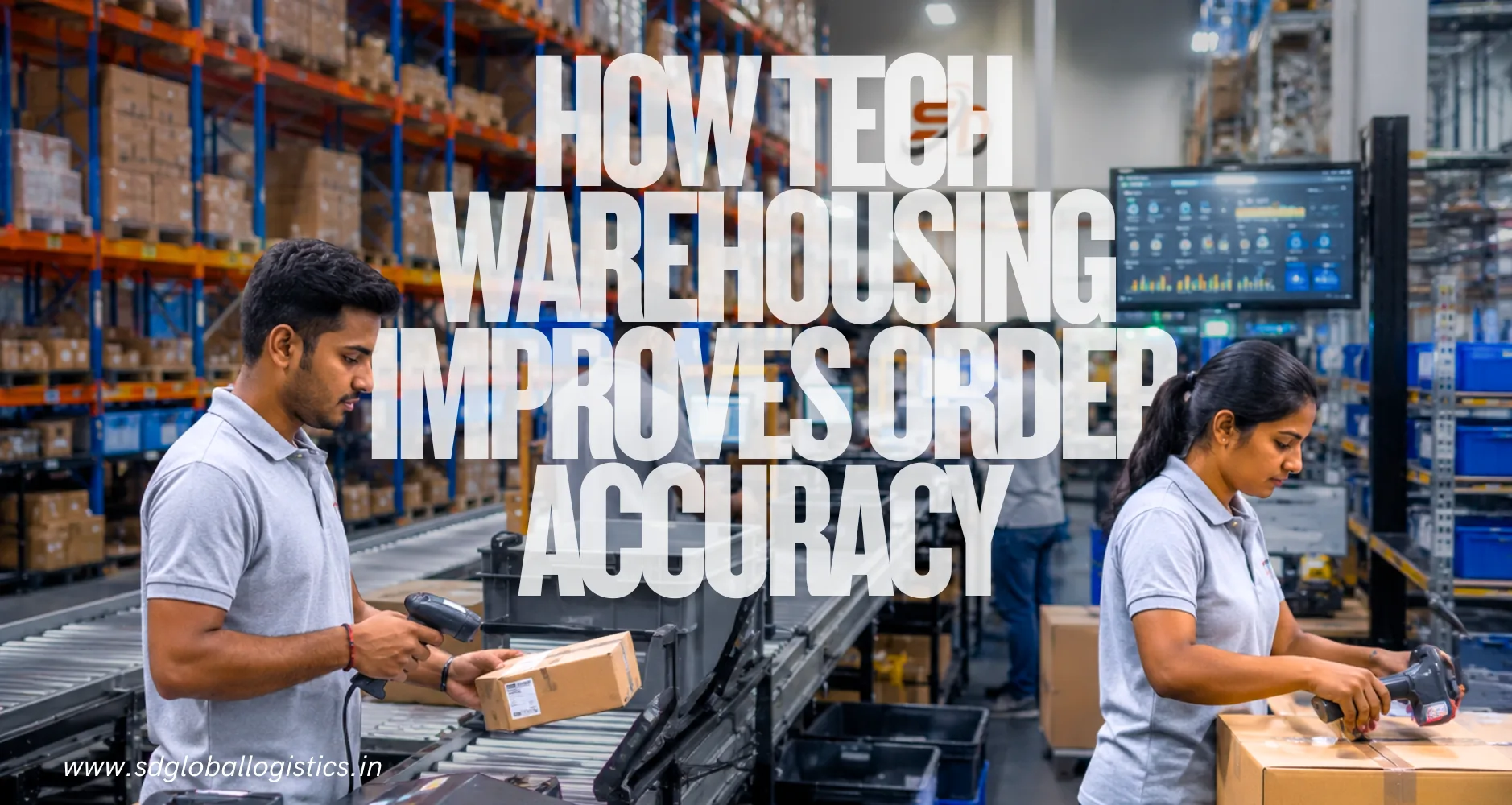
The incorrect SKU goes into a carton. A customer in Lucknow gets 2 units instead of 3 units. In Chennai, a distributor receives a wrong order. What follows is predictable — returns, refunds, sour relationships and margins that quietly drain away. In a market where speed and precision are paramount, tech-driven warehousing has emerged as the most effective solution for Indian ecommerce brands, manufacturers, and distributors to boost order accuracy and safeguard their long-term success.
The Indian warehouse industry is rapidly evolving. The India warehouse automation market is expected to reach USD 0.56 billion in 2025 and grow at a CAGR of 18.14% to reach USD 1.29 billion by 2030. Enterprises are now turning to automation instead of labour-intensive processes because of the strong demand for ecommerce, consolidation due to the Goods & Services Tax (GST) and SKU proliferation driven by Production-Linked Incentive (PLI).
The businesses that thrive in this environment won't be the ones doing things the old way. They'll be the ones that embrace warehouse technology solutions designed for accuracy, speed, and scale.
These days, the importance of order accuracy in the logistics sector has grown significantly in India. Order accuracy is not only an operations measure but a direct measure of customer experience of your brand in warehousing. In a country where quick commerce promises 10-minute deliveries and ecommerce consumers are spread across Tier 1, 2, and 3 cities, there's zero margin for fulfillment errors.
India's e-commerce market is estimated to be worth US$ 125 billion in 2024, expanding to US$ 345 billion by 2030 at an 18.4% CAGR. As order volumes surge, so does the cost of getting them wrong. One mispick is a domino effect of rework processes — return processing, re-picking, re-shipping, and customer service calls, and inventory recon. Every step reduces your operating budget, and your customer's patience. 63% of national ecommerce orders already arrive outside metro cities and it is clear that fulfillment networks are extending beyond the capabilities of manual methods. No matter if you're a D2C brand with your operations at Bengaluru or a manufacturer at Delhi NCR, you can't afford to overlook the warehouse fulfillment accuracy.
Tech-enabled warehousing is not just an acquisition of a single shiny tool. It's about layering interconnected smart warehouse solutions that catch errors before they ever reach the customer. Here are the technologies making the biggest impact across Indian warehouses.
A warehouse management system is the backbone of every modern fulfillment operation. It guides all warehouse tasks, from inbound and outbound to picking, packing and shipping. A WMS assigns tasks as per priority, validates each step on the fly, and raises alerts on deviations before they turn into expensive errors.
AI, robotics, and cloud-based WMS are pivotal in today's Indian warehouses, improving efficiency with technological advancements. Cloud-based warehouse management systems (WMS) are becoming increasingly popular, providing visibility into inventory and enhancing collaboration among suppliers, warehouses, and logistics providers.
Without an effective warehouse management system, you're operating blindly. It's the single most impactful investment you can make for warehouse inventory accuracy.
One of the quickest ways to get picking mistakes is by manually entering the data. A barcode scanning warehouse system eliminates guesswork by human operators at receiving, putaway, picking, and shipping every time.
When a picker scans an item, the system instantly confirms whether it matches the order. Then the scan fails, and the error will be discovered on the floor, not at the customer's doorstep. Real-time item tracking with barcode and RFID scanners, pick-to-light and voice-assistance solutions are becoming common in fulfillment centres in India. Such solutions are easy to deploy, easy to integrate and perfect for businesses in Tier 1-3 cities. They're not intended to take the place of labor, but to improve the accuracy and productivity.
Warehouse automation technology has come a long way from conveyor belts. Today's automated warehouse operations include autonomous mobile robots (AMRs), robotic picking arms, automated storage and retrieval systems (AS/RS), and AI-powered sortation.
With the rapid growth of e-commerce, logistics, and manufacturing sectors, businesses are increasingly deploying automated guided vehicles (AGVs), robotic arms, and autonomous mobile robots (AMRs) to streamline order fulfillment and inventory management.
After a shift, robots don't get tired. They do not misread labels, or take the wrong item. This consistency is the reason for achieving accuracy rates of 97% to 99.9%. Some leading businesses have achieved 20% to 50% better service levels and a 25% to 50% reduction in fulfilment costs.
Artificial intelligence adds a predictive layer to warehouse process optimization. Instead of reacting to errors after they happen, AI helps prevent them entirely.
AI-powered systems are being used for predictive analytics, demand forecasting, and real-time tracking, reducing human errors and labor costs. AI-driven slotting places high-velocity products in the most accessible locations, reducing the chance of a picker selecting the wrong item. Predictive demand forecasting ensures the right stock is available in the right quantities — preventing the substitution errors that creep in during stockout situations.
IoT sensors enable real-time visibility, while digital twins allow operators to simulate bottlenecks before they occur. The chances of picking the wrong product are significantly reduced when you know where every product is in real time within the warehouse.
IoT-enabled tracking is particularly valuable for Indian businesses managing multi-warehouse networks across states — a common requirement in the post-GST era of consolidated distribution.
The advantages of greater order accuracy go beyond just reducing returns. Let's take a look at how businesses in India are different when they invest in logistics technology solutions:
Lower operational costs: Fewer errors mean fewer returns, less rework, and reduced customer service overhead.
Higher customer retention: Accurate, on-time deliveries build loyalty, especially in competitive ecommerce categories like fashion, electronics, and FMCG.
Better inventory control: When picks are accurate, your inventory records stay clean — improving forecasting and replenishment cycles.
Faster throughput: Technology-guided workflows eliminate bottlenecks, speed up fulfillment, and support same-day and next-day delivery mandates.
Scalability across geographies: Whether you're expanding from metros to Tier 2 and Tier 3 cities, structured processes and systems scale far more reliably than manual ones.
Order picking is often the highest cost activity in a warehouse, and even small increases in accuracy can have a significant impact, with monthly savings of lakhs of rupees for mid-sized operations.
India's warehousing sector isn't just growing — it's professionalising. The Indian warehousing market grew by 42% YoY in H1 2025. The demand for warehousing in Tier II and III cities increased 41% year over year between 2022 and 2023, at 16.4 million square feet
Government initiatives are adding further momentum. The National Logistics Policy aims to reduce logistics costs from 14% to under 10% of GDP by 2026, driving significant demand for efficiency through automation. The PM Gati Shakti Master Plan's USD 13.5 billion investment in multi-modal connectivity is upgrading supply chains and increasing the need for smart, automated warehousing.
93% of Indian firms planned to increase automation budgets in 2023, with 66% boosting funding by 25% or more — a clear signal that the market is ready for the shift.
Manual processes are a no-go for Indian ecommerce brands and manufacturers, distributors, and enterprises seeking scalable warehousing solutions. There is only one way to overcome it and that is technology.
All warehouses don't begin at the same level. Others are still largely paper-based. Others have a basic WMS but need to add layers of automation. The key is finding a warehouse technology provider who understands your current maturity level and can build a phased roadmap.
Here's what to look for in a warehouse fulfillment partner:
Scalable warehousing services that grow with your business — not solutions you'll outgrow in 18 months.
Integration capabilities — your WMS, ERP, OMS, and transportation systems need to communicate seamlessly.
Proven expertise across industry verticals relevant to India: FMCG, ecommerce, fashion, pharma, consumer durables, and manufacturing.
Pan-India network with infrastructure in key logistics hubs and growing Tier 2/Tier 3 markets.
Data-driven approach the right partner measures everything, from pick accuracy to cycle times, and uses that data for continuous warehouse efficiency improvement.
Whether you're a startup shipping 500 orders a day or an enterprise managing multi-state distribution, the evaluation criteria remain the same: reliable technology, deep operational expertise, and a genuine commitment to your growth.
The warehouses that succeed in 2026 and beyond won't be the ones with the most floor space. They'll be the ones with the smartest systems, the tightest processes, and the highest accuracy rates. For Indian businesses navigating explosive ecommerce growth, SKU proliferation, and rising customer expectations, tech-enabled warehousing is the foundation everything else is built on.
If you're serious about improving order accuracy in warehousing, reducing fulfillment costs, and scaling operations without sacrificing quality — the time to invest in warehouse management solutions is now.
Companies like SD Global Logistics are working toward exactly this vision, building structured, technology-enabled warehousing and scalable logistics operations across India. For businesses seeking a dependable warehouse fulfillment partner with a focus on process accuracy and operational discipline, that kind of approach matters.
The question isn't whether your business needs smart warehousing solutions in India. The question is how quickly you can get there.
Tech-enabled warehousing refers to the use of modern technologies — including warehouse management systems, barcode scanning, robotics, AI, and IoT — to automate and optimise warehouse operations. To increase order accuracy, order speed, and order efficiency throughout the order fulfillment process.
From picking to packing, to dispatch, a WMS directs and validates all warehouse processes on the fly. It helps workers select the right products, detects mismatches immediately, and keeps the inventory count accurate – all of which directly help to reduce fulfillment errors.
The best-in-class warehouses have an order accuracy rate of 99.5% to 99.9%. The majority of the operations range from 96% to 98%. The best way to fill that gap is by investing in warehouse technology solutions, such as Warehouse Management Systems, barcode scanning and automation.
Absolutely. Many Indian brands are opting for modular automation — flexible, cost-effective and scalable automation as per demand. Smart warehousing solutions have become an option for even small and emerging D2C brands and regional distributors with the availability of cloud-based WMS platforms, mobile barcode scanners, and automation-as-a-service models.
India's ecommerce market is one of the fastest-growing in the world, with consumers spread across metros and Tier 2/Tier 3 cities. — particularly in fashion and electronics — make warehouse fulfillment accuracy essential for protecting margins, reducing reverse logistics costs, and building customer trust in an intensely competitive market.
From growing businesses to established enterprises, companies rely on SD Global Logistics to manage critical warehousing and logistics operations.















" We struggled with inconsistent inventory handling until SD Global stepped in with dedicated warehousing and tight process control. Their attention to detail brought stability to our entire supply chain. "

" Reverse logistics was a major pain point for us. With SD Global’s reverse logistics management and WMS integration, we finally got the visibility and efficiency we needed. "

" As a growing startup, flexibility was key. SD Global’s on-demand warehousing and responsive support scaled with us without locking us into rigid contracts. "

" Order delays used to slow us down. Thanks to SD Global’s order fulfillment and B2B logistics, we’re now running faster and more reliably than ever. "

" Our nationwide expansion needed a reliable network. SD Global’s Pan-India 3PL and shared warehousing model gave us the reach and agility we were missing. "
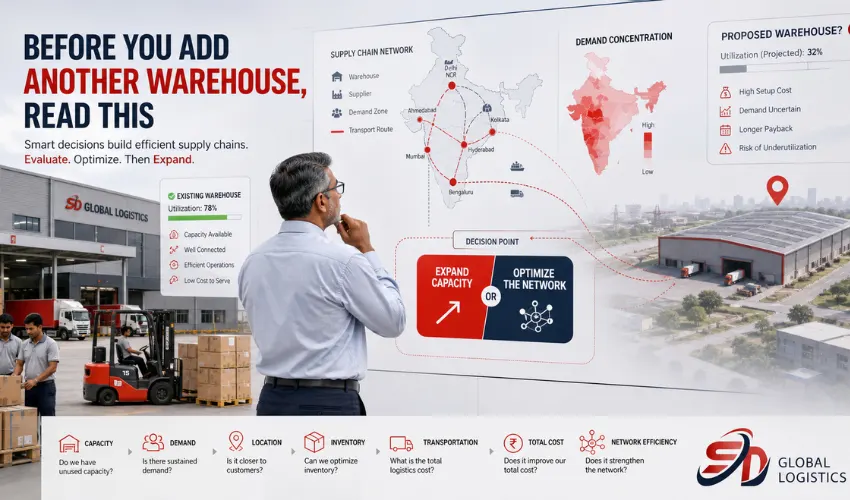

The answer is not always to build another warehouse. Before making a decision on an expansion, companies should look at true capacity utilization, inventory location, customer distribution, transportation costs, operational efficiency....
View Blog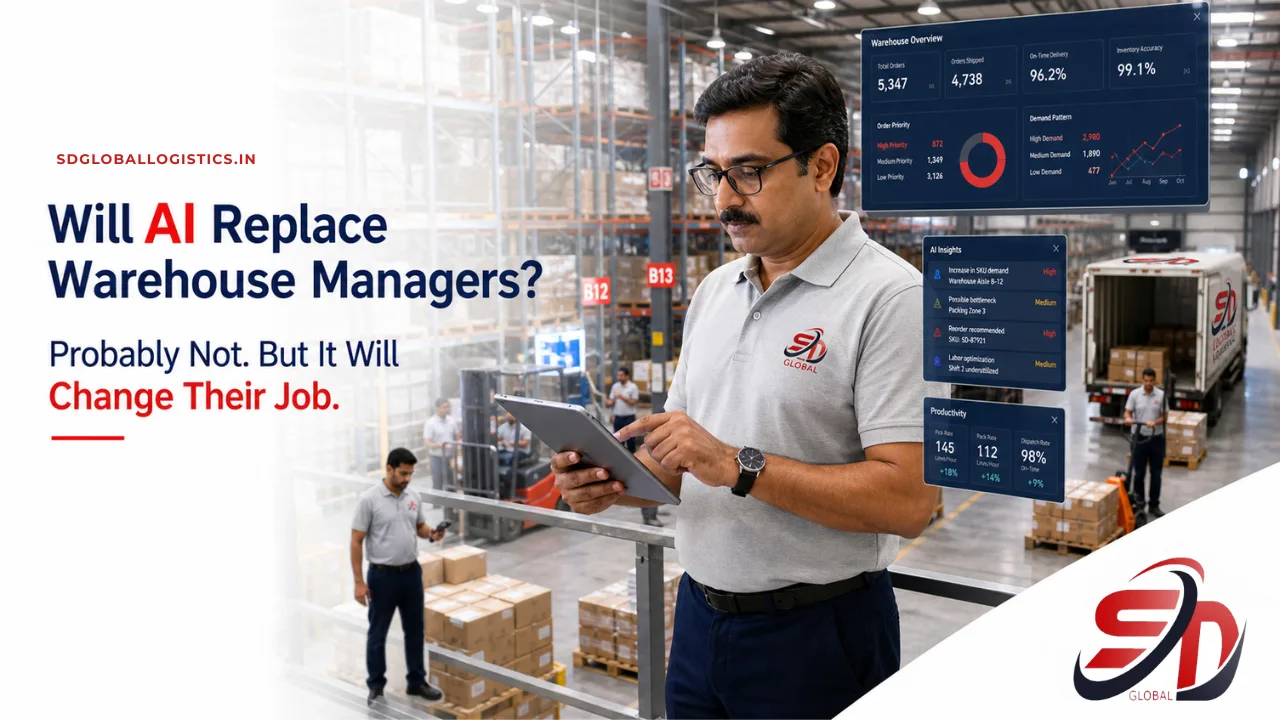
Warehouse managers will not be replaced by AI. Human judgment, leadership, exception handling and real-time coordination are still required in warehouses.But AI will be making more routine decisions — and get managers in the habit of data-driven management....
View Blog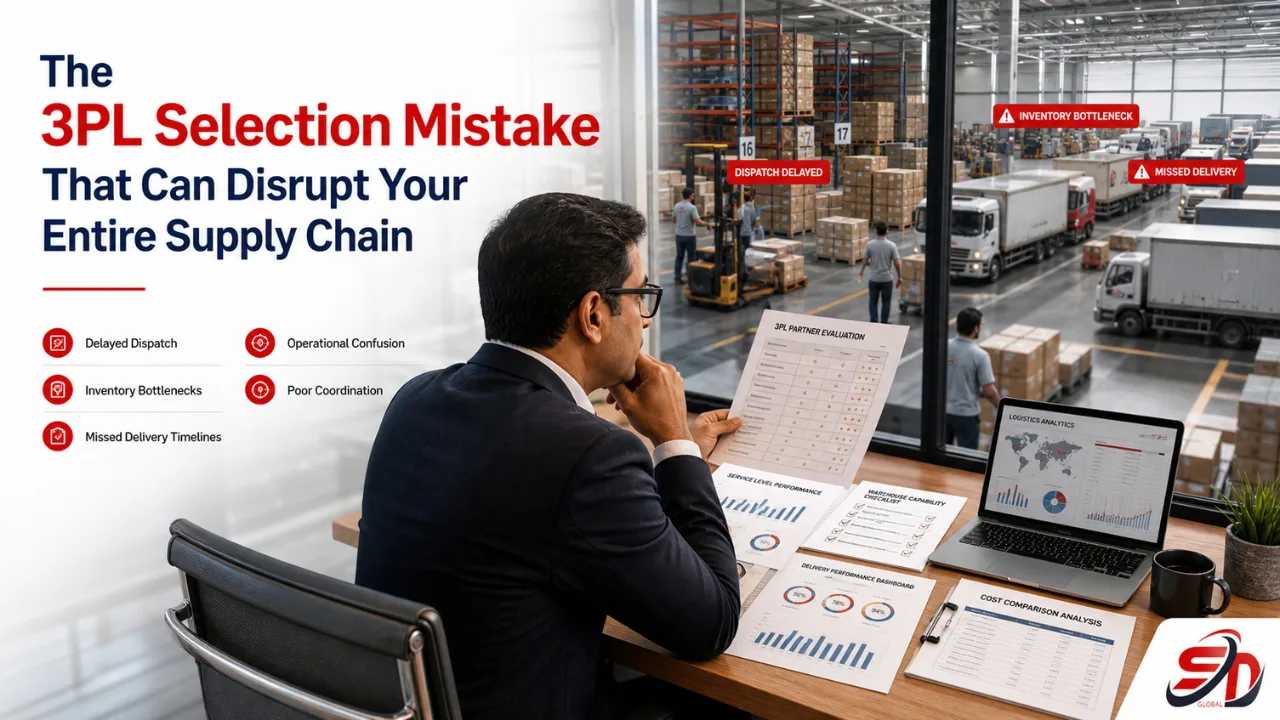
The most common error that companies make when choosing a 3PL is simply looking at the cost or warehouse capacity without assessing operational capability, technology, network, scalability, service levels and supply chain impact.
View Blog75+ warehouse locations positioned across major industrial, commercial and distribution markets.
Marcus
Ask me anything, I am here to help you.