

Marcus
Ask me anything, I am here to help you.
Enquiry Form
Enquiry Form
This is one of the situations that all emerging businesses in India have encountered at some stage. Your product is selling well in Chennai. The warehouse is in Delhi, though. Every order means a long haul, high freight cost, and a 5-to-7-day delivery window that your competitor beats by two days.
You lose the sale. You lose the customer.
Now imagine a different reality. You have inventory in Mumbai, Pune, Chennai, Hyderabad, Kolkata and Delhi all under the one intelligent system. Orders placed in Tier 2 cities reach customers the next day. Freight costs drop. Customers come back.
That is the power of a well-designed Pan-India warehousing network.
For businesses looking to grow beyond metro markets, enter new geographies, and compete on delivery speed, a warehouse network across India is no longer optional. It is the infrastructure your scale depends on.
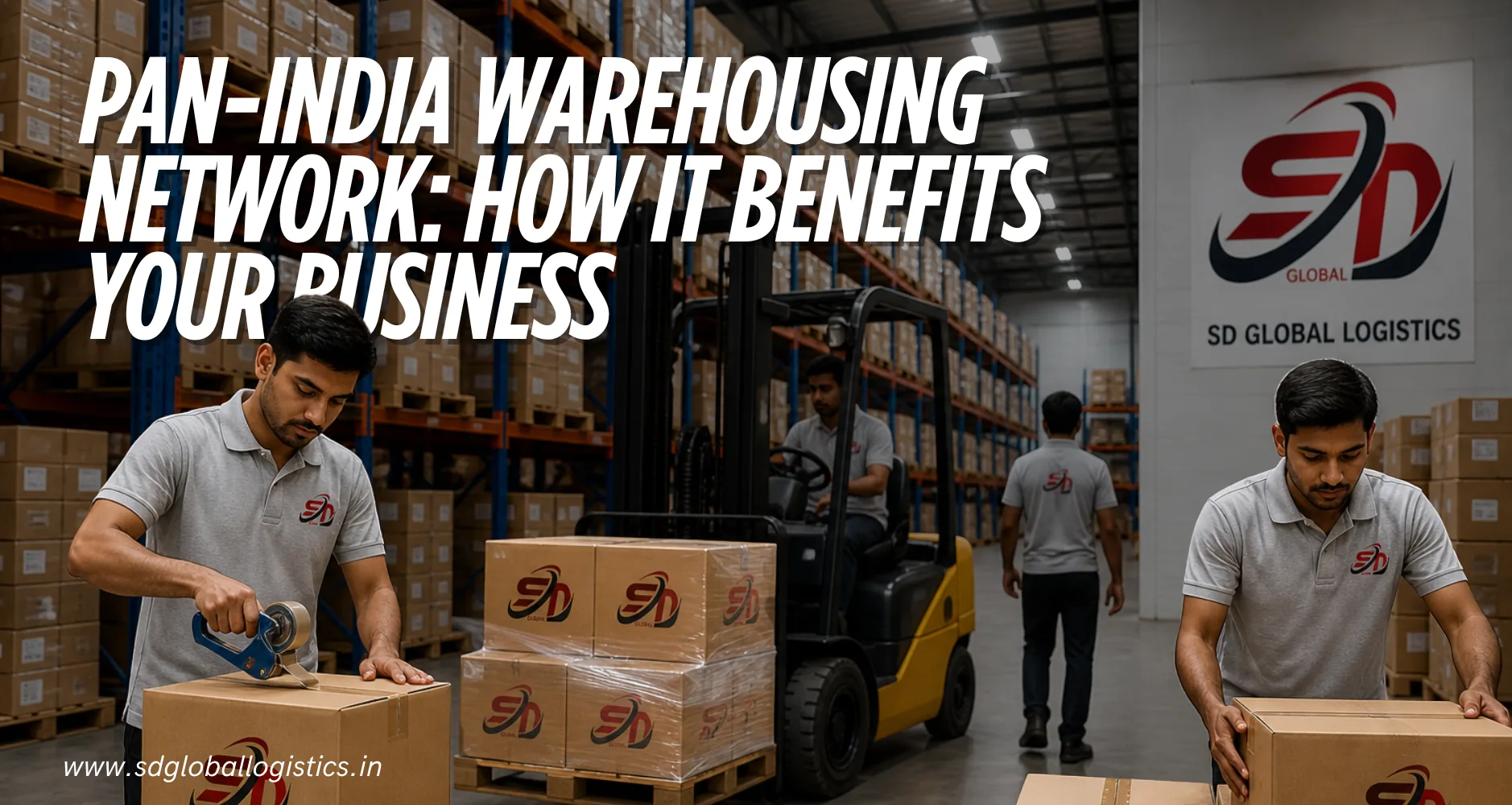
A Pan-India warehousing network is a system of strategically located warehouses spread across multiple states and cities in India. These facilities are linked with each other and their combined technology, combined inventory information and combined distribution network India which ensures that goods reach all corners of the country in no time.
Unlike a single central warehouse model, a multi-location warehousing India approach places your inventory closer to where demand actually exists. The outcome is reduced delivery distances, reduced shipping rates and reduced order fulfilment - in metro cities and remote Tier 3 towns.
This model operates by using 3PL logistics services in India - where a third-party logistics provider operates on your behalf, managing the warehouses, the transportation, the technology, and the manpower.
Instead of investing in their own warehouses and logistics teams, businesses partner with a 3PL provider to handle end-to-end storage and order fulfillment activities in a more efficient and cost-effective manner.
The numbers speak clearly. The Indian warehousing market is in a phase of sustained, structural growth — and businesses that act now will hold a significant advantage.
The India Warehouse Market size is estimated at USD 38.99 billion in 2025, and is expected to reach USD 59.34 billion by 2030, at a CAGR of 8.76% during the forecast period. India's industrial and warehousing leasing hit a record 27.1 million sq. ft. in H1 2025, up 63% year-on-year, led by strong demand from 3PL and e-commerce players. Leasing by 3PL firms stood at about 3.5 million sq ft and was 1.8 times higher than Q1 2025, supported by growing outsourcing trends, network expansion and supply chain modernization.
Industrial and warehousing demand across India's top eight cities remained robust in Q1 2026, with Grade A leasing reaching 11 million sq ft, marking a 22 percent year-on-year growth. Looking ahead, a growing emphasis on supply chain resilience, rising demand for modern Grade-A facilities, and continued expansion into emerging Tier-I and Tier-II logistics hubs are expected to drive the next phase of growth in 2026. Occupiers are likely to prioritise network efficiency, faster delivery capabilities, and technology-enabled warehousing solutions, creating fresh demand across strategic corridors.
Businesses that build or partner into a strong logistics network India today are positioning themselves on the right side of this shift.
Before discussing solutions, it is worth naming the problems clearly. Most businesses operating without a Pan India warehouse services structure deal with the same recurring challenges.
Rising online spending in smaller urban centres is reshaping the Indian warehouse market, as 63% of national e-commerce orders already originate outside the metros.
Yet most businesses still operate from a single central warehouse. The result is long delivery windows for customers in Tier 2 and Tier 3 cities — exactly the customers who are now driving India's consumption growth.
Shipping every order across 1,500 to 2,000 kilometres adds up fast. Long-haul freight is expensive, inconsistent, and hard to forecast. It eats into margins without adding customer value. A distributed warehousing network India solves this by dramatically reducing last-mile distances.
Too much stock in one city. Zero stock in another. Without real-time inventory management solutions India, businesses either overstock at one location or face stockouts that cost them sales. Both outcomes damage profitability.
Managing multiple vendors, tracking shipments across disconnected systems, and reconciling data from different states is a drain on time and resources. As businesses scale, this fragmentation becomes a serious operational bottleneck.
If any of these sound familiar, a Pan-India warehousing network is the structural fix your business needs.
When inventory is stored closer to the customer, delivery timelines shrink significantly. A majority of 3PL companies have warehouses in the main logistic centers near the major consumption markets. By holding inventory closer to customers, businesses can save on transit time, increase the speed of delivery, and achieve a greater customer satisfaction.
To D2C brands, companies utilizing e-commerce as a channel to sell their products, and FMCG companies, faster delivery is a direct competitive advantage that drives repeat purchases.
The 3PL warehousing is based on the shared-cost model, where the storage space, labor and transportation are optimized among multiple clients. This assists companies to enjoy economies of scale, reduced per-order fulfilment expenses and predictable logistics costs.
When your distribution network India is built around proximity to demand, freight savings are immediate and compounding.
A warehousing network India supported by the technology allows one to learn about the stock in all locations in real-time. Most modern 3PL providers offer WMS-enabled operations that provide real-time inventory tracking, order status updates, and SKU-level accuracy. Such visibility can help businesses to manage stocks in a highly efficient manner across various markets and eliminate overstocking and stockouts.
Better inventory management solutions India means lower carrying costs, fewer write-offs, and more accurate demand planning.
The peak seasons that India has Diwali, Big Billion Days, end-of-season sales can increase order volumes by triple overnight. A Pan-India warehousing network provides the capacity to scale up without capital investment.
The process of establishing a warehouse within a new market entails a lot of time, capital and adherence to regulations. Under 3PL warehousing, the companies could expand to new areas immediately by leveraging the existing warehouses.
This on-demand scalability is what separates resilient businesses from those that collapse under peak pressure.
Effective supply chain management India is about removing friction at every node — from procurement to last-mile delivery. A national warehouse network eliminates the single-point failures that plague centralized models.
3PL offerings empower producers, merchants, and exporters to handle complex supply chains, resulting in increased operational efficiency, decreased costs, and improved delivery performance across different demand centers all over India.
Establishing your own warehouse network in India needs a lot of real estate investment, licensing, manpower recruitment and deployment of technology. That is not feasible for most growing businesses.
The collaboration with one of the existing warehouse service providers India provides you with immediate access to ready infrastructure. Considering the collaboration with a stable third-party logistics provider, brands will have access to ready-to-use warehousing infrastructure, advanced technology, and expertise in logistics. This helps them to scale operations effectively, streamline fulfillment processes, and enter new markets much faster and more confidently without making heavy investments in physical warehouses, manpower, or systems.
Modern warehousing solutions in India are not about square footage alone. They are powered by automation, artificial intelligence, and real-time data.
Automated guided vehicles and conveyor systems are increasingly being implemented by operators to improve their efficiency of operations and shorten turn around times. Artificial intelligence and machine learning can be integrated to conduct predictive analytics to demand forecasting and optimizing inventory across warehousing networks. The increasing adoption of technology such as warehouse management systems (WMS), transportation management systems (TMS), and route optimization software is streamlining operations and reducing costs. The technology makes it possible to manage inventory more effectively, provide better delivery times, and enhance transparency throughout the supply chain.
Every hour your team spends managing warehouses, coordinating truck movements, or auditing inventory is an hour not spent on product, marketing, or customers.
Brands can focus on growth, innovation, and customer engagement while leaving logistics complexities to the experts.
That is the most underrated benefit of outsourcing to 3PL logistics services in India — the strategic freedom it creates.
Contract logistics services India refers to a long-term agreement between a business and a 3PL provider to manage end-to-end logistics operations. It goes beyond simple storage.
Dedicated warehousing at multiple locations across India
Inbound and outbound transportation management
Order picking, packing, and dispatch
Real-time WMS and inventory reporting
Returns processing and reverse logistics
Value-added services including labelling, kitting, and quality checks
Consumer-goods majors are replacing fragmented trucking contracts with single-window 3PL relationships that envelop primary haulage, cross-docking, and value-added tasks such as kitting and labeling.
This shift from transactional logistics to strategic partnerships is defining how India's most competitive businesses operate their supply chains in 2025 and beyond.
Not every product can be stored the same way. A strong Pan-India warehousing network is built to accommodate the specific needs of each sector.
| Industry | Key Warehousing Requirement |
|---|---|
| FMCG | High-velocity stock movement, expiry tracking, batch management |
| Pharmaceuticals | Temperature-controlled storage, GDP-compliant facilities |
| E-Commerce | Fast picking, high SKU volumes, same-day dispatch capability |
| Automotive | Large-format storage, DG compliance, JIT delivery |
| Fashion & Retail | Season-based inventory management, omnichannel fulfilment |
| Agriculture & Food | Cold chain infrastructure, humidity-controlled storage |
Refrigerated warehousing is forecast to grow at 12.11% CAGR, supported by a cold-chain sector moving from USD 11.64 billion in 2024 to USD 18.19 billion by 2029
A quality warehouse service provider India offers purpose-built solutions for each of these verticals — not a one-size-fits-all approach.
The policy environment in India is also encouraging the development of a modern logistics network in India.
The Indian government's comprehensive infrastructure development programs including PM Gati Shakti and the National Logistics Policy are creating an enabling environment for warehousing sector growth. Within the Nagpur Multi Modal Logistics Park (MMLP) under the PM Gati Shakti program, commercial operations in the park started in 2025, providing integrated warehousing, cargo handling and multimodal connectivity, which directly supports the existence of efficient storage and distribution networks. GST eliminated inter-state tax barriers, companies moved to large hubs and reduced transit times up to 40 percent and consolidated inventories. Government initiatives such as the Urban Infrastructure Development Fund (UIDF), which allocates Rs 100 billion annually to upgrade infrastructure in Tier-II and Tier-III cities, are playing a pivotal role in accelerating growth in the warehousing and logistics sector.
Businesses that plug into this policy-backed infrastructure environment today will hold a structural cost and speed advantage over those that wait.
Choosing the right warehouse service provider India is as important as the decision to build a Pan India warehouse services strategy in the first place. Here is what separates a reliable partner from an average one:
1. Geographic Coverage:
A true Pan-India warehousing network partner operates across metro cities, Tier 2 hubs, and emerging logistics corridors — not just a few pin codes
2. Technology Infrastructure:
Look for WMS-enabled operations, real-time dashboards, and API integration with your existing order management systems. Your partner's technology is your visibility.
3. Scalable Capacity:
Your logistics partner must grow with you — handling peak seasons, new product launches, and geographic expansion without operational disruption.
4. Industry Expertise:
A warehouse service provider India that has worked across FMCG, pharma, e-commerce, and retail brings category-specific process knowledge that a generalist provider simply cannot offer.
5. Transparent SLAs and Reporting:
Clear service-level agreements, on-time dispatch rates, and inventory accuracy metrics are the foundation of a trustworthy contract logistics services India relationship.
As businesses focus on flexibility, speed, and scalability, third-party logistics has become the backbone of modern commerce.
Are your delivery timelines longer than those of your key competitors?
Are freight costs eating more than 10-12% of your total revenue?
Do you face stockouts in some regions while overstocking in others?
Is managing multi-vendor logistics taking time away from your core business?
Are you planning to expand into Tier 2 or Tier 3 cities in the next 12 months?
If you answered yes to even two of these questions, the case for multi-location warehousing India is clear. The cost of inaction — in lost sales, inefficiency, and missed markets — is higher than the cost of building the right infrastructure.
A Pan-India warehousing network is a network of linked warehouses in various parts of India, which is managed by a single technology and operation. Businesses need it to reduce delivery times, lower freight costs, manage inventory accurately across regions, and serve customers in Tier 2 and Tier 3 cities competitively. With the growing rate of online demand by non-metro India, a network of warehouses in India is necessary to sustain its growth.
By placing inventory closer to end customers through multi-location warehousing India, businesses significantly reduce last-mile shipping distances. This lowers per-order freight costs, reduces damage in transit, and eliminates expensive emergency restocking runs. Combined with the shared-cost model of 3PL logistics services in India, businesses also benefit from economies of scale they could never achieve with a single internal warehouse.
Regular warehousing is just a storage area. The Contract logistics services is a fully managed and long term logistics partnership involving warehousing, transportation, inventory management, order fulfilment, returns handling, and value-added services all under one SLA-driven agreement. It will convert logistics into a cost centre into a competitive capability.
The biggest beneficiaries include industries that have a high volume of SKUs, sensitive delivery needs, or a specialized storage need. These are e-commerce, FMCG, pharmaceuticals, automotive, fashion retail, agriculture and food processing and consumer electronics. . Each sector benefits from purpose-built warehousing solutions in India that address their unique compliance, speed, and inventory requirements.
Evaluate providers on the depth of their logistics network India (city and state coverage), the sophistication of their WMS technology, their experience in your specific industry, scalability during peak periods, and the clarity of their SLA commitments. The right warehouse service provider India functions as a true operational partner — not just a vendor.
From growing businesses to established enterprises, companies rely on SD Global Logistics to manage critical warehousing and logistics operations.














" We struggled with inconsistent inventory handling until SD Global stepped in with dedicated warehousing and tight process control. Their attention to detail brought stability to our entire supply chain. "

" Reverse logistics was a major pain point for us. With SD Global’s reverse logistics management and WMS integration, we finally got the visibility and efficiency we needed. "

" As a growing startup, flexibility was key. SD Global’s on-demand warehousing and responsive support scaled with us without locking us into rigid contracts. "

" Order delays used to slow us down. Thanks to SD Global’s order fulfillment and B2B logistics, we’re now running faster and more reliably than ever. "

" Our nationwide expansion needed a reliable network. SD Global’s Pan-India 3PL and shared warehousing model gave us the reach and agility we were missing. "
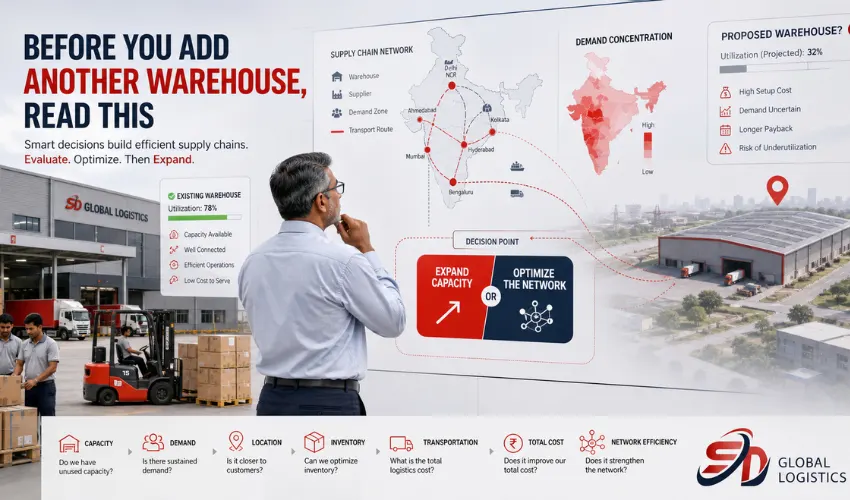

The answer is not always to build another warehouse. Before making a decision on an expansion, companies should look at true capacity utilization, inventory location, customer distribution, transportation costs, operational efficiency....
View Blog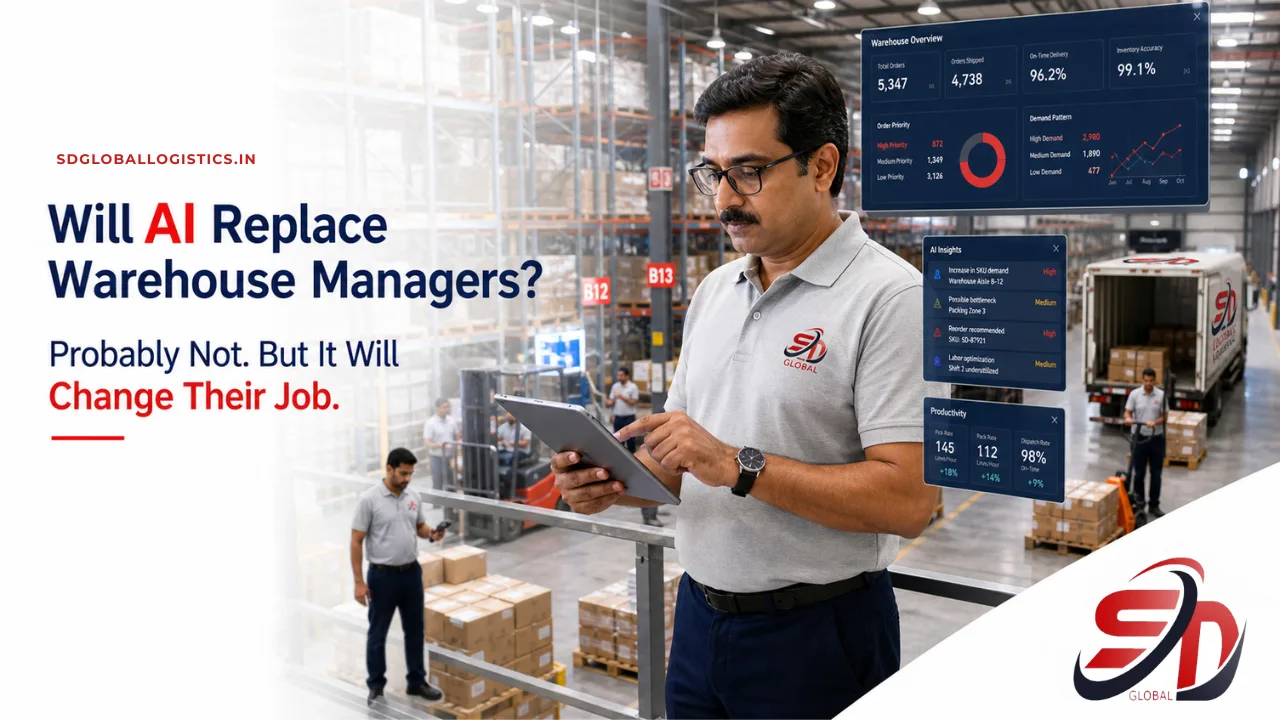
Warehouse managers will not be replaced by AI. Human judgment, leadership, exception handling and real-time coordination are still required in warehouses.But AI will be making more routine decisions — and get managers in the habit of data-driven management....
View Blog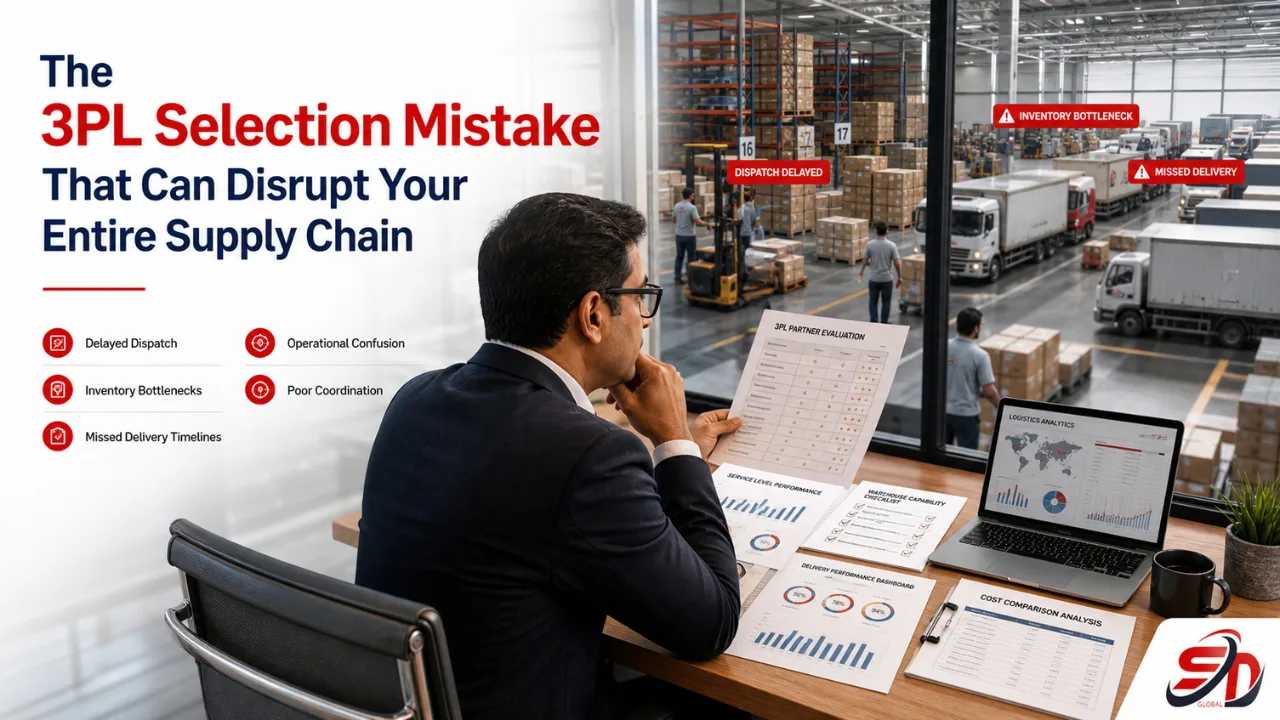
The most common error that companies make when choosing a 3PL is simply looking at the cost or warehouse capacity without assessing operational capability, technology, network, scalability, service levels and supply chain impact.
View Blog75+ warehouse locations positioned across major industrial, commercial and distribution markets.
Marcus
Ask me anything, I am here to help you.