

Marcus
Ask me anything, I am here to help you.
Enquiry Form
Enquiry Form
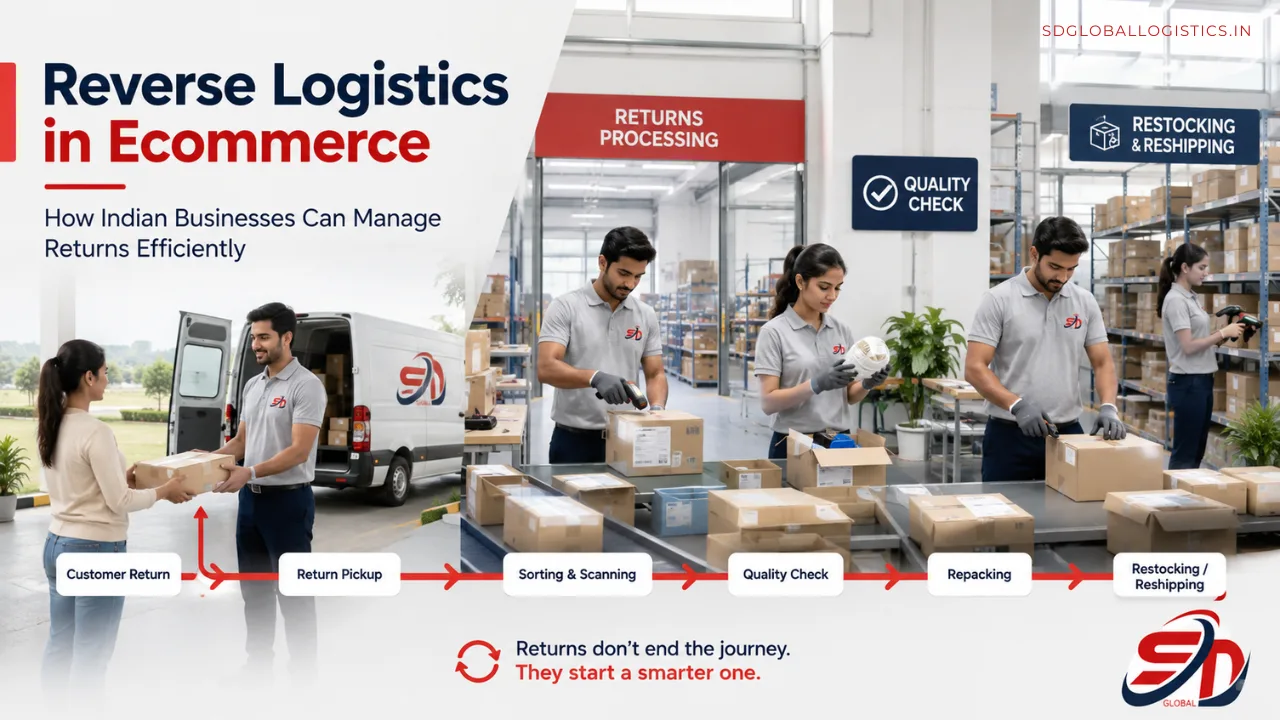
Reverse logistics in ecommerce is the process of moving products from customers back through the supply chain — for inspection, sorting, restocking, replacement, resale, recycling, or disposal. Unlike forward logistics, which moves goods from warehouse to customer, reverse logistics handles everything that comes back.
For ecommerce companies in India, reverse logistics can’t be a neglected part of their operations. These return logistics costs Indian ecommerce sellers around 1.5X - 2X more than forward shipping on the return item. Every neglected/ mismanaged return slowly cuts into your business profit margin.
India's ecommerce returns landscape is uniquely challenging compared to global markets. The overall ecommerce return rate in India is in the range of 15 to 35 percent by category, with the figure being on the higher side in the case of fashion brands. This can be attributed to several factors in India:
Several India-specific factors drive this:
Most sellers underestimate the financial damage of returns because the costs are spread across multiple line items.
A single returned order involves reverse logistics cost (₹80–150), repackaging and quality-check cost (₹20–40), lost COD float (15–21 days), and product damage risk (5–8% per return cycle) — totalling ₹150–300 per order, before marketing spend to acquire that customer. COD orders that are rejected at delivery or returned after delivery create a double shipping cost — the brand pays for both the forward delivery attempt and the reverse pickup — effectively consuming margins that might have been realised on a successful sale.
At scale, these numbers compound rapidly. Indian D2C brands collectively lose over ₹8,000 crore a year to RTO, according to GoKwik .
A typical reverse logistics cycle in Indian ecommerce follows these steps:
Each step introduces potential delays and costs. Without a structured system, products sit idle in reverse transit for days, distorting inventory counts and blocking resale opportunities.
Unlike forward logistics — which is linear, standardised, predictable, and scalable — reverse logistics is variable, costly, fragmented, and often opaque.
Indian sellers face additional complications:
Verify addresses at the point of shipment, address Non-Delivery Report (NDR) concerns within 24 hours, and restrict Cash on Delivery (COD) at pincodes with high return rates, using courier performance data to route orders away from poor-performing partners.
The return to Origin (RTO) rates ranges 28–35% for COD transactions and 4–8% for prepaid orders. Small nudges, such as a discount of ₹50 on a prepayment, can have a significant impact on the nature of your payments and reduce return volumes.
A D2C fashion brand selling 3,000 COD orders per month at 28% RTO improved their rate to 16% through AI confirmation calls — saving an estimated ₹7.2 lakhs per month on shipping and reverse logistics.
Forward-looking companies are creating dedicated returns hubs inside warehouses – with repair workstations, quality control testing, and recycling areas. Having a separate returns processing area in your ecommerce warehouse keeps returns from blocking your live fulfilment process.
Not all of the ecommerce fulfillment companies excel in reverse logistics. Specifically rate your 3PL or logistics partner on the aspects of reverse pickup coverage, QC turnaround time and returns data visibility. Reverse logistics costs are higher than forward logistics because of the many hidden costs involved, which makes Indian ecommerce and D2C businesses hesitant to allow returns — but returns have become a necessity rather than an option.
A more effective approach is to engage in an exchange-first strategy; a branded return page that provides options for exchanging rather than receiving a refund and offers store credit, allowing for the highest level of customer satisfaction and profitability. Every refund converted to an exchange saves you a customer acquisition cost.
Platforms like Cashify, Amazon Renewed, and Flipkart enable open-box resale, refurbished sales, and liquidation — forming a secondary market that helps recover value from products that can't re-enter your primary sales channel.
Most Indian ecommerce businesses treat returns as a cost centre. The brands that grow profitably treat them as an operations problem worth solving.
It helps to build customer confidence and trust in a well-managed return process. Customers who know they can return products easily are more likely to complete their initial purchase — and return for future orders.
An efficient reverse logistics system in ecommerce reduces unnecessary costs, recovers inventory faster, and creates the kind of buying experience that builds repeat customers. India's reverse logistics market is projected to reach USD 39.81 billion by 2027 — and the businesses that invest in strong returns management services today will be best positioned to scale profitably as the market grows.
If you're running an ecommerce operation in India — whether a D2C brand, marketplace seller, or multi-channel retailer — your reverse logistics capability is no longer optional. It's a core part of your fulfilment strategy.
From growing businesses to established enterprises, companies rely on SD Global Logistics to manage critical warehousing and logistics operations.












" We struggled with inconsistent inventory handling until SD Global stepped in with dedicated warehousing and tight process control. Their attention to detail brought stability to our entire supply chain. "
" Reverse logistics was a major pain point for us. With SD Global’s reverse logistics management and WMS integration, we finally got the visibility and efficiency we needed. "
" As a growing startup, flexibility was key. SD Global’s on-demand warehousing and responsive support scaled with us without locking us into rigid contracts. "

" Order delays used to slow us down. Thanks to SD Global’s order fulfillment and B2B logistics, we’re now running faster and more reliably than ever. "

" Our nationwide expansion needed a reliable network. SD Global’s Pan-India 3PL and shared warehousing model gave us the reach and agility we were missing. "
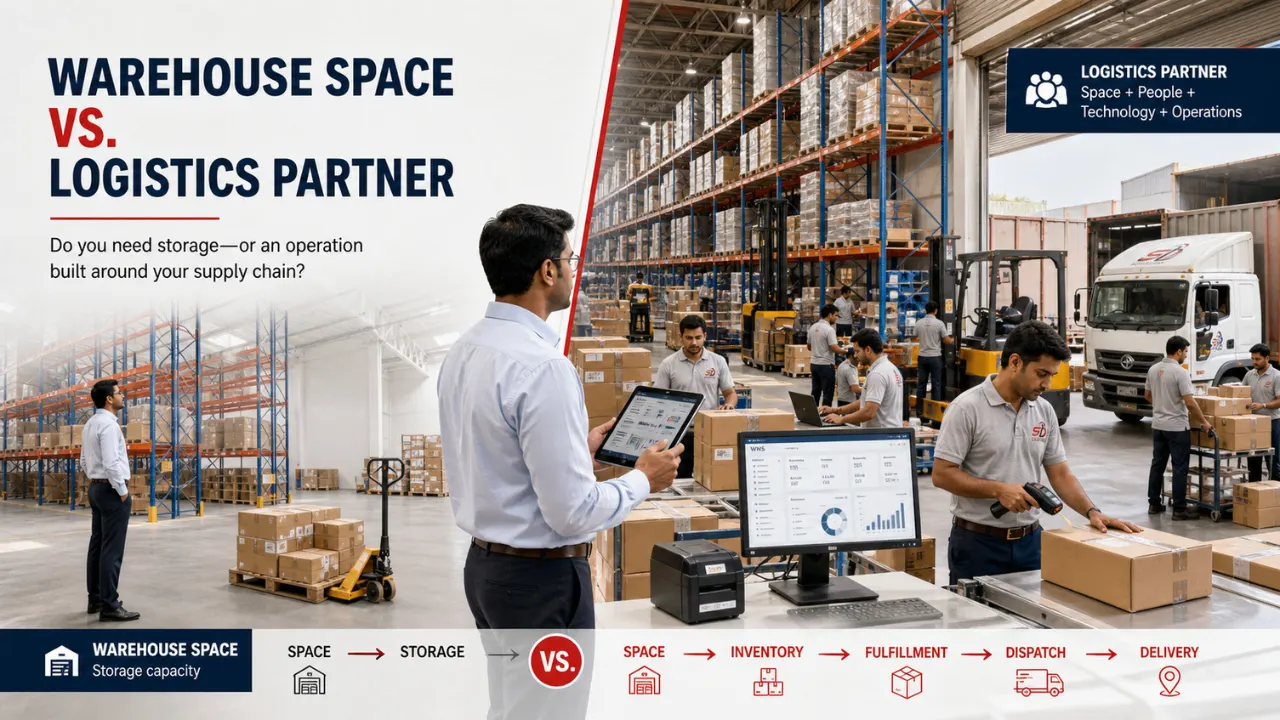

Hiring a warehouse gives your business a place to store inventory. With the hire of a logistics partner, you have the people, process, technology, fulfillment and expertise needed to effectively manage that inventory........
View Blog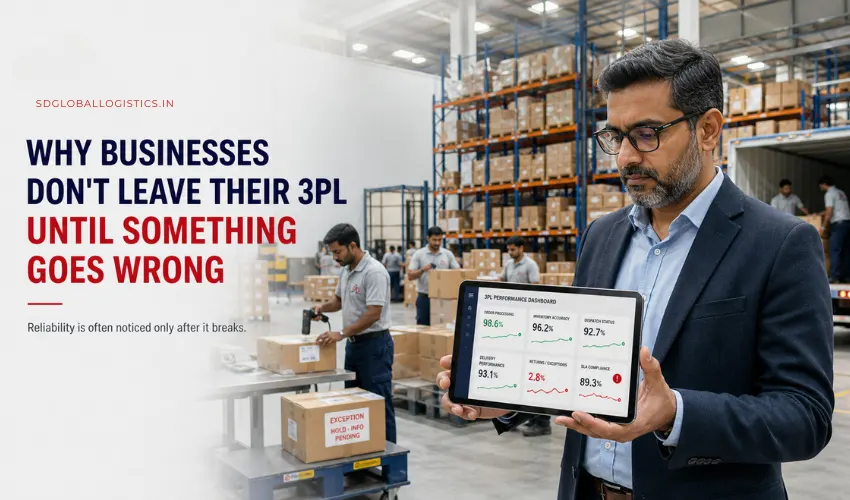
The reason many businesses remain with the same 3PL is that it is actually challenging to change warehouses, systems, processes, inventory, and transportation partners.When problems begin to impact customers, costs....
View Blog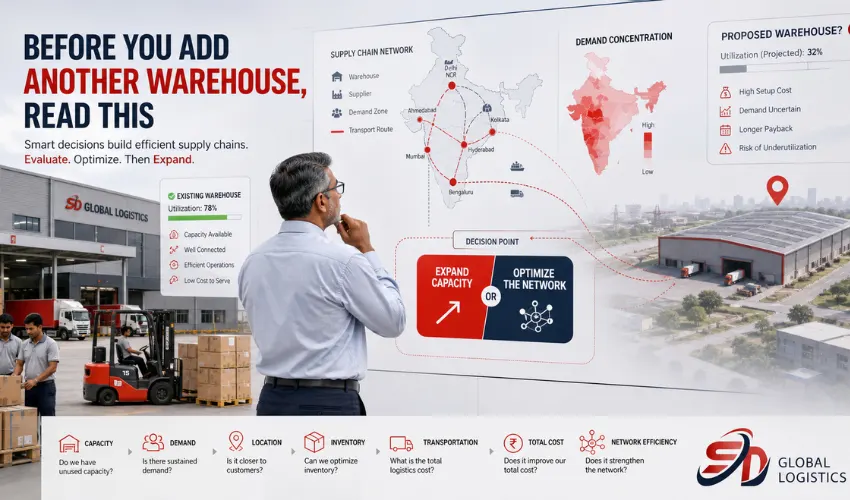
The answer is not always to build another warehouse. Before making a decision on an expansion, companies should look at true capacity utilization, inventory location, customer distribution, transportation costs, operational efficiency....
View Blog75+ warehouse locations positioned across major industrial, commercial and distribution markets.
Marcus
Ask me anything, I am here to help you.